
Trinity Sunday, year B, May 26, 2024
In a time of national distress, elders of the Jews tell a story of the ancient Moses. He had told the people of his day why they should be proud of how they differed from their pagan neighbors, instead of envying them.
The following is part of Saint Paul's long argument that Christians are not saved by keeping the Law of Moses, and not required to keep it. We are saved, rather, by the grace of God. Adoption is one metaphor Paul uses for how God saves us.
Saint Matthew's original audience was Jewish Christains struggling with rejection by other Jews and unwelcome interest from Gentiles. The evangelist finishes his gospel by transforming an earlier commandment of Jesus. He had once sent his disciples only to the lost sheep of the house of Israel. Now he sends them to all people.
The Literary Method: Deuteronomy retells history told in other books, punctuating the narrative with powerful speeches by Moses. Just as Deuteronomy's audience was having a very hard time holding on to faith and identity, so, the book reminds them, it was a struggle for their predecessors, ancient Israelites, to achieve or to maintain their strict belief in the one, true and invisible God. Elements of their past and enticements from pagan neighbors combined to tempt them. We're tempted to say, "the more things change, the more they stay the same."
In today's reading, a classic "pep talk," Moses gives the people all the reasons to be proud of how they're different from their pagan neighbors, instead of envious of them. He's saying "we have a better God who gave us a better law and we're a better people. There's no other god like ours, nor law like ours, and no other people like us, so shape up!"
Proclaiming It: To prepare to read this, recall when you've had to speak this way to a child or student of yours. Or recall a coach's locker-room half-time talk that motivated you. Think of George C. Scott's speech at the beginning of the movie Patton. Then imagine how much greater were the stakes when Moses first spoke this, and when the Deuteronomists (authors of the book), had to tell the story again. Finally, determine to make your congregation relive the Israelites' experience of hearing this. You want them to feel as proud of their God and of themselves as Moses did.
As part of his grand argument, Paul spends the early verses of Romans, chapter 8 contrasting the flesh and the spirit; life according to the flesh is not just hedonism, it's trying to win God's favor with your own efforts alone. Life in the spirit is letting God take over.
Interestingly, in the New American Bible translation of Romans 8, "spirit" and "Spirit" appear alternately over and over, as if the translators can't tell when Paul meant "the Holy Spirit" and when he meant "spirit" as our general disposition to let God reign in our lives. It matters little. And it brings us to Proclaiming It In Our Liturgical Situation: This reading addresses some of the relations between Spirit, Father and Son, as we experience our relationship with God. In your proclamation, don't try to make clear the inter-Trinitarian relations. You'll serve the congregation much better by emphasizing the expressions adoption, children and heirs. Contrast "adoption" with "slavery." Sound excited about yet another way to be united with Christ, as "joint heirs." Contrast "suffer with him" and "be glorified with him," so they sound like two poles of the same experience.
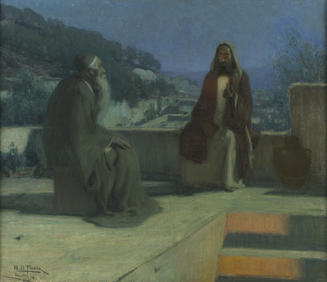
Nicodemus Visiting Jesus by Henry Ossawa Tanner, 1899.
Of the artist, Wikipedia says "Henry Ossawa Tanner was ... the first African-American painter to gain international acclaim. He moved to Paris in 1891 to study, and decided to stay there, being readily accepted in French artistic circles." Tanner died in 1937.
The painting is owned by the Pennsylvania Academy of the Fine Arts (United States - Philadelphia). Click here for a larger version, and more about the painter.. The site the-athenaeum.org has images of 135 of Mister Tanner's paintings, many of which are of religious subjects.
This page updated April 25, 2024