Trinity Sunday, June 4, 2023
Hoping for renewal after captivity in Babylon, Jewish leaders retold the story of their ancestors' exodus from Egypt. In this episode, God chooses to do a great act of friendship, according to the custom of the time, revealing his name.
In pagan Greek Corinth the Christian community had a few factions and some serious misunderstandings of the gospel. In closing his second letter to them, Saint Paul gives advice aimed at unifying and strengthening them.
John's gospel aimed to help some indecisive Christians make the break with their past and embrace Jesus. Early in his gospel, John tells of a Jewish leader inquiring of Jesus. Jesus contrasts his teaching, mission and person with everything the Pharisee expects.
The Historical Situation: Moses has been leading the Hebrews through Sinai on their way to the Promised Land for a long time (thirty-four chapters, by one measure) before he enjoys this revelation from God. To ancient people, it was a very big deal to know the name of a god; they perceived the gods as mysterious and secretive. So for Moses, this is a sacred, privileged moment. A lector should try to capture that in his or her proclamation.
The Theological Background: Our text uses the word "Lord" to render a Hebrew expression that even now is hard for scholars to translate. As close as we can come in Roman letters, it's "Yahweh." A sentence as much as a name, it means something like "I am who am." Yes, that's all. That's the best we can do at rendering the name that God gives himself. Orthodox Jews express their reverence for God by refusing ever to pronounce this name. They substitute the word "Lord" for it when the come upon it in a reading. We observe the same reverent protocol.
Proclaiming It: Your task is simply to pronounce this title/name with all the dignity it deserves. Imagine you are Moses re-telling this story: "And then He finally told me his name. [pause dramatically] . . . It's LORD". [another pause] "Then he said it again, 'The LORD, the LORD, merciful, gracious, slow to anger, rich in kindness and fidelity' Wow, I was speechless! I bowed down in silent worship. Then I timidly asked Him to accompany us, though we're such rag-tag group."
So when you come to the sentence (where Moses is addressing God), "do come along in our company ...," try to sound like Moses would have sounded: stunned by a divine revelation totally unexpected (divine revelation should always be unexpected), you nevertheless want this God to accompany your unworthy people.
The Historical Situation: Most of Paul's letters begin with some doctrinal chapters, where he makes theological points and corrects misunderstandings of the gospel. Later chapters of the letters usually deal with community discipline. Then they conclude with affectionate farewells. Our reading today is the conclusion of the second letter to the Corinthians. We see a little of the discipline and the affection.
Proclaiming It: Clearly the editors of our lectionary chose this passage for today because of the trinitarian formula at the very end. Here's a chance for you to practice slowing down your proclamation. Don't speed through these phrases, the way we sometimes speed through the sign of the cross. Make the congregation hear every word, the name of every Person, clearly and distinctly.
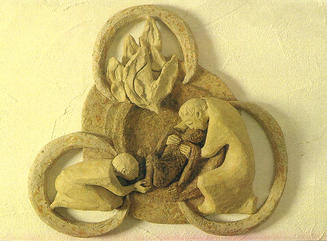
The Merciful Trinity, artist unknown.
My little-trained eye noticed a trefoil motif that goes back at least as far as decoration of medieval churches. Theologically, I like the inclusion of the fourth person, object of the care of each of the other Persons. I'd like it more if the fourth person were more robust.
I found the picture on this Spanish-language page, a subdomain of this site, which appears to belongs to the Brothers of the Christian Schools, a Roman Catholic order of men who run schools and do other works of mercy. They're known in the U.S.A. as the Christian Brothers. The Brothers give the image the title The Merciful Trinity. As we shall see, it's not clear what the artist called it.
The Brothers' spirituality page does not seem to name the artist. They leave a clue in the file name they give the image, trinitat_barro. The page sites as source of the image this page from another Spanish Catholic site in 2009. To the best of my reading of the Spanish, this page does not name the artist either.
Using the Google tool described here, I found numerous other pages that use the image. Pursuit of the identity of the artist is, as they say, left to the reader as an exercise.
This page updated May 31, 2023