
In the Roman Catholic Church, August 25 is the annual feast of Saint Louis IX, King of France. Churches in the Archdiocese of Saint Louis, Missouri, USA, (where Lector's Notes originate) may observe the feast, even on a Sunday. One liturgical authority there, in 2024, says churches should proclaim the readings of the 21st Sunday in Ordinary Time, Notes for which are on this page.
However, another St. Louis liturgical authority authoizes local churches to proclaim saint-specific readings this Sunday. Click here for those readings and Lector's Notes about them.
August 25, 2024, 21st Sunday of Ordinary Time
Written during Israel's late exile, the book of Joshua gives a somewhat idealized recollection of Israel's early exodus. This story describes early Israel's loyal choice of God as if that was an instant, wholehearted decision, with no struggle or doubt.
In this instruction, Saint Paul affirms some social arrangements common in his day, but revolutionizes others, and grounds them all in our relationship with Christ.
In prior verses from John 6, Jesus has said some things that not all can accept. His words today put that rejection in its proper context.
The Theological Background: Among the ancient Israelites, basic questions about God were not as cut and dried as we see them in our own day. They were not so at the time of the events described here, around 1200 BCE, when Joshua succeeded Moses in leading God's people on their trip from slavery in Egypt to a new life in the promised land. Nor were they settled even at the time this was finally written down (in the sixth century BCE, near the end of the Exile, when the uprooted people began to have hope of going back to the land). John A Grindel, C.M., in The Collegeville Bible Commentary -- Old Testament (Collegeville, Minnesota: The Liturgical Press, 1992), says the purpose of the book of Joshua
"with its emphasis on the conquest and division of the land, is to show the fidelity of God to the promises made in the past to the patriarchs and Moses--particularly the promise of the land. One of the chief themes found in the Pentateuch [the five books prior to Joshua in the Hebrew Scriptures] is the promise of land. That promise is fulfilled in the Book of Joshua so as to engender in the people a trust in God's promises. Now Israel in the midst of the Exile, can trust in God's continuing care and presence, and trust especially that the promise of the land remains in force. At the same time, obedience to the Law is important lest, having been forgiven and brought back to the land, Israel again bring down upon her head such destruction as she is now experiencing."
The Historical Situation: So the people described in this historical episode had not made firm religious commitments yet, for it was only a generation or two since the Lord had revealed himself to Moses. They still have multiple options, and Joshua states them starkly: They may do only one of the following
Proclaiming the Passage: The oft-quoted, beautiful line
Then make the people's response sound lively and enthusiastic. That's tough because they don't just say a hearty "Yes! Amen!" They recite a whole creed. Unless you work at it and rehearse, you may sound like a contemporary congregation reciting the Nicene Creed in autopilot mode. Instead, try to capture the newness of this all to the historical participants. They're only a generation away from slavery. They're inexperienced nomads wanting to settle down. They've re-adopted a long lost religion. Something new and exciting is afoot, and they're in it, hearts and souls.
The Historical and Theological Background: Early in this letter Paul praises God for finally revealing the long secret plan of world salvation: In Christ, the Gentiles have finally come to enjoy the favor of God long reserved for the Jews. The two groups are united, now, in Christ. And while the Jewish Law doesn't save anybody, The Gentile people had lived for generations without the Law's excellent moral guidance. They're due for an ethical upgrade, if we may use a term so anachronistic. Now there were plenty of other teachers instructing people about morals and domestic life. What makes Saint Paul's teaching distinct is how he places his doctrine in the context of the mystery of Christ. It's not simply that wives should be obedient and husbands should be loving. It's that both these "stances" express the relationship of the Church to Christ.
To prepare to proclaim this, study it carefully so you understand everything said here about the Church and our relationship to our Lord. You should be able to give the answers that Paul would give to these questions:
Proclaiming the Passage: All that is more important than the teaching about domestic relations (the words "Christ" and "Lord" appear seven times in eight the sentences). Your challenge is to proclaim this in such a way that your listeners get the bigger picture.
In some congregations, verses 21-24 will be controversial (though not for the same reasons they were controversial originally) unless lector, preacher and assembly treat them intelligently. This burden falls primarily on the preacher (and the parish's adult education team), and requires knowing even more about the verses' background and original intent than stated here. (See links in the grid, below.)
But the lector can contribute, too. First of all, be sure you can recite the verses with a straight face. If your spouse will be in the congregation that you serve as lector, talk over the passage and these Lector's Notes, and rehearse the reading at home with your spouse listening.
If you are lector in an intimate assembly like a college Newman Center, or where congregants hold all their opinions strongly, especially positions about gender relations, you may want to provoke some special preparation for everyone. What you want to prevent is anyone snorting, laughing or groaning because they're surprised by the assertion "Wives should be submissive to their husbands." Better to get the liturgy committee and presider to defuse the issue with a brief teaching before mass, or a concise introduction that you as lector can deliver before the reading. If you're reading Lector's Notes more than a week before the 21st Sunday of Ordinary Time, you're probably ahead of everybody else. Start talking to them today.
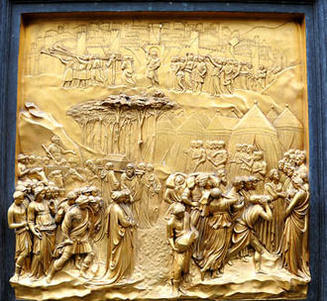
Scenes from the book of Joshua. The artist is Lorenzo Ghiberti (Italian 1378-1455). The work is part of his east door of the Battistero di San Giovanni, Florence, Italy. The photo is from the travel blog of Ferrell Jenkins, who generously says, "The photos we publish may be used by teachers and ministers in various types of educational presentations, including PowerPoint and handouts, as long as credit is given for the source of the photo."
This page updated August 5, 2024