Twenty-first Sunday of Ordinary Time, August 27, 2023
Isaiah spoke several oracles against Judah's pagan neighbors, as we would expect. But he also denounced Jerusalem and its corrupt leaders. This passage predicts the firing of an official of the king's court, and his replacement by a leader who will remind everyone of King David from their glorious past.
In three prior chapters, Saint Paul has figured out how God will bring all peoples into the grace of Jesus Christ, even the Israelites who, by rejecting Jesus, seem to have given up their status as the Chosen People. The brilliance and subtlety of the plan inspire this hymn of God's praise.
Ancient Middle Eastern people were always concerned about how other people regarded them. Jesus, too, asked his friends what others were saying about him. They gave the routine reports, then one different and surprising opinion.
The Historical Situation: Chapters 13 through 23 of Isaiah are oracles in which the prophet pronounces God's judgment against various nations. Babylon, Assyria, Syria, Tyre, Sidon and Egypt all take their licks, as you might expect. But chapter 22 is directed at Jerusalem, capital of Judah and home of many of God's chosen people. In particular, a royal official named Shebna gets severely criticized and told that he will have to yield to a replacement named Eliakim. When Isaiah promises the "key of the house of David" to Eliakim, he's summoning the memory of Judah's long-gone greatest king, and the happy memory of an old golden age. We read this passage today only to prepare ourselves to hear the day's gospel, Matthew 16:13-20, where Jesus grants Peter "keys to the kingdom of heaven."
Proclaiming It: So emphasize the parts about the key, and "when he opens, no one will shut," etc.
Here are acceptable pronunciations of the difficult Hebrew names:
The Theological Background: What had Paul so excited? In Romans, chapters 9-11, Paul speculates on how the Jews, always God's chosen people, could apparently forfeit their chosen status by failing to accept Jesus. Since we don't get to read the whole passage, let me summarize it. God's plan calls for the Jews to reject Jesus so that a few believers, like Paul, would be forced to carry the good news outside Judaism and evangelize the Gentiles. When Gentiles are converted, the Jews will be impressed, not to mention jealous, and accept Christ themselves. The result will be the salvation of the whole world and the reconciliation of Jews and Gentiles, goods even greater than the election of Israel. The ancient promise of God to Abraham will not go unfulfilled.
Proclaiming It: This beautiful passage calls for careful oral interpretation. Saint Paul is so excited about something he has written in prior paragraphs that he bursts into this rhapsodic praise of God. Try to capture Paul's mood when you proclaim this passage to the congregation.
Chances are the congregation won't know the background. But let them know that you, like Saint Paul, have some reason to give glory to God.
Extra! Each Sunday passage from Romans in context: Click here to see a table summarizing the readings from Romans from the 9th to the 24th Sundays of Ordinary Time, this year.
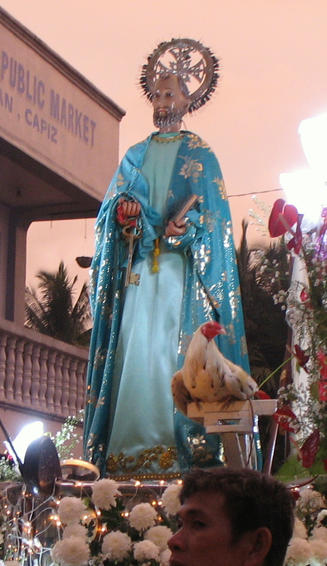
Photographer unknown, Saint Peter With Keys and Rooster (detail), from a Holy Week procession in Ivisan, Philippines, courtesy of Art in the Christian Tradition, a project of the Vanderbilt Divinity Library, Nashville, Tennessee, U.S.A. Permalink to complete version
This page updated August 13, 2023