
Twentieth Sunday of Ordinary Time, year A, August 20, 2023
With their exile in Babylon ended, Judeans returned to Jerusalem, expecting to offer sacrifices in the temple on Mount Zion again. Some ethnic boundaries had gotten blurred during the exile, so the prophet has to pronounce on the acceptability of sacrifices by outsiders.
Saint Paul believes that even though mainline Jews have rejected Jesus, God's faithfulness to ancient promises requires that they eventually convert. He speculates on how that might come about.
This gospel preserves a memory that Jesus himself once held a narrow vision of his mission, and found it challenged by an outsider.
The Historical Situation: Many things were changing for the people of Judah during and after their exile in Babylon, 587-540 B.C.E. The third part of the book of the prophet Isaiah, chapters 56-66, was written for returned exiles, and the left-behind ones whom they rejoined, during the time of the rebuilding of Jerusalem. The experience of the exile had challenged the people's faith to its roots. A specific land and a flourishing population had seemed essential to their covenant with God. By their sins could they have broken the covenant irreparably? How could God restore everything? Clearly things were never going to be the same again, but what would life be like now?
To make things even more interesting, the prophet recorded in Isaiah 56-66, known as Third Isaiah or Trito-Isaiah, expressly reinforces a new element of God's relationship with the people, broached before but little emphasized. God, the prophet now insists, is interested in other nations of people besides the descendants of Abraham. The covenant is offered more widely than the first people of the covenant ever dreamed. Their exclusive claims to chosen status must yield and make room for strangers.
Proclaiming It: Today's passage first gives a general reassurance about God's intention to renew the covenant. If you can, make yourself sound hopeful as you proclaim the first sentence. Then pause. The rest of the reading announces the radical change in the covenant, the welcoming of foreigners. In reading it aloud, you should emphasize the words referring to the newcomers, as the prophet would have in announcing this to the people for the first time. So:
Our Liturgical Setting: The Lectionary often chooses passages from this section of Isaiah to prepare us to hear gospel passages like today's, Matthew 15:21-28. The struggle to broaden the covenant was not complete even by the time Jesus came. Jesus himself was ambivalent about it, as today's gospel shows. For a survey of Lectionary references to Isaiah, click here, then click on the letter "I" in the top frame. In a rare congruence, our second readings last Sunday, today, and next Sunday also address the issue. Of course the locus classicus for the narrative of this struggle is The Acts of the Apostles.
The Theological Background: As these Notes showed last week, In Romans 9-11 Paul asks how God could apparently renege on the promise made to Abraham, that Abraham's descendants would always be God's chosen people, now that those descendants had rejected Jesus. Paul figures out that it was God's plan all along to allow the Jews to reject Jesus, so that the few Jews who accepted Jesus would be forced to turn to the Gentiles, long the outsiders, and bring them into the covenant. Then the Jews would become jealous and accept Jesus, and God's long secret plan to invite all people into the covenant would be revealed and completed.
By "their rejection is the reconciliation of the world," Paul means the Jews' rejection of Jesus allows the world (the pagans, the Gentiles) to be reconciled to God. By "what will their acceptance be but life from the dead?" he means that the Jews' coming back to God by accepting Christ is tantamount to them receiving life again through the once spiritually dead pagans.
Proclaiming It: Make sure you know the referent of every pronoun in this passage, and that you contrast them properly with tones of voice. Paul ("I") is a Jew speaking to pagans ("you") about the Jews ("my race," "some of them") and so on. Every third-person pronoun here refers to the Jews, and every second-person pronoun to the just-converted Gentiles. Let your listeners hear the differences.
Extra! Each Sunday passage from Romans in context: Click here to see a table summarizing the readings from Romans from the 9th to the 24th Sundays of Ordinary Time, this year.
I previously cited a popular article, now gone from its original website, about honor and shame in ancient (and contemporary) Middle Eastern culture. It explained the exchange of insults between Jesus and the Canaanite woman (today's gospel). The article summarized the scholarship on the topic by Doctor John J. Pilch.
In the absence of that article, you might try this scholarly version of Pilch's teaching. (The link is working as of July 9, 2023.) Here's the abstract:
A previous study presenting Jesus as a master of insult (Pilch 2012:158–162) regularly raised objections from readers or listeners whose image of Jesus is ‘gentle and lowly of heart’ (Mt 11:29). The objection failed to recognise key features of Middle-Eastern culture. It is agonistic, that is, conflict prone. Insults, thus, are customary and expected verbal and non-verbal weapons for initiating and sustaining conflict. Furthermore, people from the Middle East live comfortably with inconsistency, so much so that this cultural feature has been identified as ‘normative inconsistency’ (Malina 1986). Jesus, ‘gentle and lowly of heart’, can suddenly lose his temper and cause a ruckus in the Temple (Mt 21:12–13; Mk 11, 15–19; Lk 19:45–48; Jn 2:13–17). The cultural puzzle in this scene is not the inconsistency between gentleness and violence in Jesus’ behaviour but rather the fact that not one of his disciples intervened to restrain him as is commonly expected in Middle-Eastern and circum-Mediterranean cultures. In this article, I present a social scientific model for understanding insult and examine Matthew’s Gospel with insights from that model.
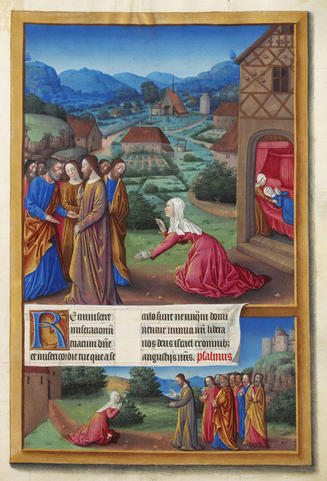
Herman de Limbourg, Jean de Limbourg and Pol de Limbourg, all approximately 1385-approximately 1416. The Canaanite Woman asks for healing for her daughter, from Art in the Christian Tradition, a project of the Vanderbilt Divinity Library, Nashville, TN. Permalink [retrieved July 1, 2017; still working July 9, 2023]. (The Permalink page invites you to download graphics of the image in 3 sizes.)
From the wikipedia article about the artists:The Limbourg brothers (Dutch: Gebroeders van Limburg or Gebroeders Van Lymborch; fl. 1385 – 1416) were famous Dutch miniature painters (Herman, Paul, and Johan) from the city of Nijmegen. They were active in the early 15th century in France and Burgundy, working in the style known as International Gothic. They created what is certainly the best-known late medieval illuminated manuscript, the Très Riches Heures du Duc de Berry.
This page updated August 13, 2023