July 9, 2023, Fourteenth Sunday of Ordinary Time
The prophet Zechariah gives a portrait of Judah's king. Not a conqueror out to glorify himself, this king stands for justice, peace, and allegiance to the highest sovereign, who is God.
Saint Paul teaches that to be "in the flesh" is to try to earn God's grace by our own merits, while being "in the spirit" means letting God give us that undeserved grace.
Jesus contrasts his teachings and his expectations of his followers with the doctrine and demands of other religious authorities of his day.
The Historical Situation: The book known as Zechariah comes from two different sources. Scholars call chapters 9-14 Second Zechariah. It's later than most of what we read from the Hebrew Scriptures, from the period after Alexander the Great conquered Judah in 333 B.C.E. By this time, Judah had been a subject state for a very long time. From generation to generation, only the names of its overlords had changed. The prophet begins (Zechariah 9:1-8) by announcing that the Lord will invade the lands of Judah's foes (some near and some far) and liberate Judah. Then, in the sentences we proclaim, he describes Judah's new king.
To understand this image of the Messiah, remember two things. Christianity did not yet exist and had not appropriated the title "Messiah." The word means "anointed person" and applied to Judah's kings because anointing (not coronation) was the kernel of the royal enthronement ceremony. Secondly, a king is still a king, even if he rides on an ass. Ancient Middle Eastern potentates who paraded in horse-drawn chariots were stating that the raison d'être of their kingships and their tribes was conquest. Judah had a different royal imagery. The purposes of its kings (and of the tribe itself) was not imperialism but justice and fidelity to a higher, invisible king. Thus Judah's Messiah, when receiving the accolades of his people, rides a low-slung pack animal. (In our time, contrast the May Day parades of missiles and tanks in the old Soviet Union with the inauguration of a President of the United States, when the latter still had the security and temperament to walk to the ceremony.) (The Reverend Diedrich A. Nelson (DAN) cites a 1973 article from the Journal of Biblical Literature by Paul D. Hanson, explaining the meaning of the donkey imagery in Second Zechariah.
Proclaiming It: This passage is in the Lectionary today because its portrait of the Messiah superficially resonates with Jesus' portrait of his disciples in today's gospel, Matthew11:25-30. That's a remarkable, beautiful and moving passage, and you might try meditating on it as part of your preparation to proclaim the Zechariah. However, you'll be more faithful to the prophet's text if you steep yourself in his vision, which is more corporate. Zechariah sees not a lone humble subject, not even just a nation, but a world (sea to sea, from the [Euphrates] River to the ends of the earth) at peace, where there's no need for chariots or the warrior's bow.
Nota bene: The animal is the foal of a donkey or of an ass. That's not a misprint in your church's lectionary. It rhymes with "goal" and is not pronounced "fowl." I don't want to insult your intelligence; I only correct what I've heard. And just in case, the prophet's name is pronounced: zek uh rye uh.
The Theological Background: You may remember this passage, perhaps even this commentary, from the Fifth Sunday of Lent earlier this year. Scholars have filled shelves with books about the meaning of "in the flesh" versus "in the spirit." In my opinion, the simplest and best explanation, and one consistent with the rest of Saint Paul's teaching, is that we're in the flesh to the extent that we try to save ourselves, earning salvation by our own works, by how well we keep rules, etc. That's proud and futile. Rather we're called to be in the spirit, to let the Spirit dwell in us, sanctifying us not by our works but by the undeserved grace of God, the only power capable of bringing life from death.
For a long time, I have tried to keep here a working link to an English version of a 20th-Century theological classic, Paul Tillich's The Shaking of the Foundations. Now, it seems, good folks at sabda.org have taken up the mantle dropped by religion-online.org, doing the world a favor by posting the book online. In Chapter 16: The Witness of the Spirit to the Spirit Tillich takes up the question of flesh and spirit most eloquently and convincingly.
The main page of sabda.org is in the Indonesian language, which I cannot read. If you find chapter 16 of Shaking, or the whole book, at other sites, please notify me.
Proclaiming It: Reading this to a congregation is challenging, especially where the sentences are long. Try to break up the long sentences into sense lines, pausing briefly where that will help the listeners follow. Vary your tone of voice to bring out the contrasts between life and death, spirit and flesh, righteousness and sin.
Extra! Each Sunday passage from Romans in context: Click here to see a table summarizing the readings from Romans from the 9th to the 24th Sundays of Ordinary Time, this year.
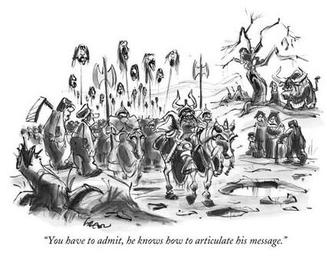
A cartoon by Lee Lorenz, published in The New Yorker. July 1, 2002. The owner of the image has moved it among various websites since I first delighted in it. Should you want to buy it, as of July, 2020, the best way is to go to https://cartoonbank.com and search for the Exact Phrase TCB-51619.
Click here for a larger but reduced-resolution version.This page updated June 25, 2023