Second Sunday of Easter, year A, April 16, 2023
Acts of the Apostles was written to introduce pagan converts to Christianity to the roots of their new religion. This is a somewhat idyllic description of a brief, early period of its history. More turbulent times are to follow.
The original audience of this letter were persecuted Christians. The author, writing from relative safety, wanted to bolster their faith. So he reminds them of their place in a larger history, reminds them of God's providence in that history, and helps them see their present sufferings in a larger context.
Jesus commissioned his followers to make others into followers, too, having patience with those troubled by doubts.
The Literary Situation: The book of Acts, chapter 1, begins with Jesus' final post-resurrection appearance and ascension. The latter half of the chapter tells of the selection of Judas' replacement within the Twelve. Acts, chapter 2, begins with the Pentecost event, followed by a long speech by Peter, at the conclusion of which "some three thousand were added [to the body of believers] that day." Then comes the passage that is our first reading today, a summary portrait of the life of the community.
The picture is very positive, as if the writer wants us to imagine a community free of persecution and without internal strife. Indeed, such may have been the case for a while. But Acts lingers in this idyllic mode only briefly, and a more gritty, more realistic portrait of community life begins within a few sentences.
Proclaiming It: Go with the flow here. Be positive. It's Easter, after all. Read this with joy in your heart. But don't rush it. Let your hearers savor every nuance of these happy believers' life together. The breaking of the bread gets two mentions. That they gathered together gets dual emphasis, too. The scholar might see in this duplication the incomplete merger of two literary sources. But the lector might just decide that these were the important things about the life of the early church, and they're just as important for the modern church. So let them be emphasized.
The Historical Situation: The writer of this letter wants to give his audience a sense of God's providential plan working out in the course of their lives and in the history of which they have become a part. Keep that in mind as you pick apart the complicated sentences that you must proclaim. There are only three sentences here, in length 71 words, 51 words, and 42 words (in the New American Bible translation). No kidding.
Let's analyze it.
The first sentence says:
  Blessed be God who has give us new birth to:
    to a living hope
      through the resurrection
    to an inheritance
      imperishable
      undefiled
      unfading
      kept in heaven
        for you
          who are safeguarded by faith
    to a salvation
      ready to be revealed.

The second sentence says:
  This makes you rejoice,
  although you suffer now.
    Suffering will prove your faith genuine
      (and your faith is more precious than fire-tried gold)
      which will result in honor when Jesus is revealed.

The third sentence says:
  You have not seen Jesus but you love him.
  You do not see him but you believe in him.
  So you rejoice because
    you are obtaining the goal of your faith,
      which is the salvation of your souls.
Note that I've been forced to break up the overlong sentences. In Proclaiming It, you can do this only with careful phrasing and varied tones of voice. To prepare, print out the text (or use your missallette) and mark up the copy with pauses, emphases, changes of tone, brackets enclosing units of thought, whatever it takes. Practice this aloud and often. Practice in front of a friendly critic who will forgo the comfort of a missallette, so he or she can tell you what you seem to be saying.
Remember the writer's goals:
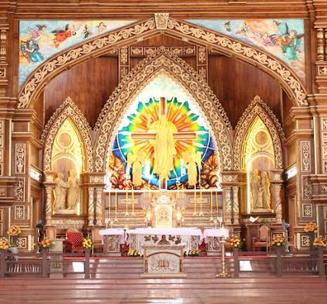
Roman Catholics like me, and other Western Christians, I suppose, think of "Doubting Thomas" first when we hear about the apostle featured in today's gospel. But Christians in India think of Thomas as the practical founder of their church. Many have great devotion to him, and have named churches for him. This one is in Maylayottoor in the state of Kerala, in south India.
Click here for a larger photo, but don't wait because Panoramio.com says it's about to close its site. They credit Share Alike by Geyo John for the photo.
As I wrote this in 2017, I was reading about the Christian churches of the East in Diarmaid MacCulloch's Christianity: The First Three Thousand Years. Should you read that book? Maybe this review can help you decide.
This page updated April 2, 2023