June 19 or 22, 2025, The Body and Blood of Christ (Corpus Christi)
To encourage his late Jewish readers to hold their heads high among their pagan neighbors, the author of Genesis recalls how an ancient priest-king saluted their ancestor Abram, whom we know as Abraham.
Paul the Apostle needed to correct several abuses among the Christians at Corinth, including discourtesies at their celebrations of the Lord's Supper. Here he makes a rare invocation of tradition that he received from even earlier Christians. He connects the Lord's Supper with the whole mystery of Christ.
An unlikely wilderness setting, an unusually large crowd, an unprecedented mix of men, women and children in public, all make this familiar miracle story even more remarkable.
The Historical Situation: The Abram in this reading is, of course, the man we are soon to know as the patriarch Abraham, founder of the people who became our ancestors in the faith. This story is from very early in Abraham's saga. He has just defeated some local "kings" and recovered from them captive kinsfolk and property.
While Melchizedek may have been a "priest of God Most High," remember that God was only beginning to reveal himself to Abraham in the special ways that would become the kernel of our tradition. So though the bread and wine mentioned are highly suggestive for us at this late date, it would be a mistake to read into this story more than the participants meant by their gestures.
(To hear "Melchizedek" pronounced, click the wedge:
That audio clip comes from BIBLESPEAK.)
Your Proclamation: The author's intention was to enhance the prestige of his ancestor Abraham, by telling of his exploits among his contemporaries (you can read the details leading up to today's passage here; and if you read the footnotes, you'll find interesting details about the term "God Most High"). Why would the author want to do that? To encourage his readers to hold up their heads among their contemporaries, to think of themselves as a people with a special calling from God, a people different from their many pagan neighbors. To be faithful to the author's intention, emphasize the praise that the foreigner Melchizedek heaps on Abram. Make Melchizedek sound like an old man who thought he had seen it all, but who is compelled to exclaim that this Abram has a really special relationship with God.
The Historical Situation: This is one of the few places where Paul solemnly states that he is handing on a tradition older than his own vocation as a Christian. The words he quotes are very similar to those ascribed to Jesus in the gospels of Matthew, Mark and Luke. Surprisingly, Paul quotes Jesus almost nowhere else.
As the larger context of 1 Corinthians 11 shows, Paul has to be very clear about his authority here because he's correcting the Corinthians severely. Misconduct at the Eucharist was one of several abuses for which the Apostle takes them to task, as readers of the whole letter, and of Lector's Notes pertaining to selections from it, know well.
To proclaim the death of the Lord is to confess one's faith in the whole mystery of Christ and all that he means for us.
Your Proclamation: The congregation listening to you is sure to be quite steeped already in the truth that Jesus gave bread and wine, declaring them to be his body and the new covenant in his blood. What you might try to let them hear anew is the doubled command, "Do this in remembrance of me." We're asked to do more than receive Jesus' gift, we're asked to do it. A pause before each such invocation would drive that home.
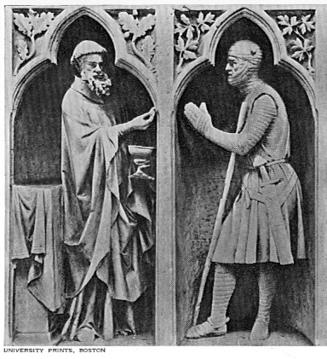
At the Cathedral of Reims, France, built in the mid-13th century, a carving that may represent Melchizedek and Abraham. It is also said to represent a priest serving Holy Communion to a warrior.
This image is borrowed from a blogger who calls herself Tee Gee. She seems to have borrowed the image from the book Du miracle grec au miracle chrétien ("From the Greek Miracle to the Christian Miracle") by Waldemar Déonna (1880-1959), a Swiss art historian.
This page updated June 19, 2025