the Ninth Sunday of Ordinary Time (most likely outside the U.S.A.).
If so, click here for Lector's Notes for that Sunday.
If you're not sure, ask your liturgy committee or pastor.
Corpus Christi, The Body and Blood of Christ, May 30 or June 2, 2024
For a people struggling to recover their past integrity, the Book of Exodus reminds them of the covenant God offered at their foundation, sealed with a ritual that woud become routine.
Some Jews who had accepted Jesus were expelled from their synagogues and even their families. They felt cut off from their whole tradition. This author tries to show them that Jesus and their new community replace everything they have lost, and give them something better.
The earliest readers of this gospel would have found parts of it strange, and parts familiar. But Jesus gives even the familiar a new meaning.
Our Liturgical Setting: This year's readings for this feast emphasize the theme of blood. Ancient peoples sealed covenants with the blood of ritually sacrificed animals.
The Historical Background: As we have stated elsewhere in Lector's Notes, the first five books of the Hebrew Bible were assembled much later than the events they describe. The Exile in Babylon and the people's return from exile were traumatic, nation-wrenching experiences that made Judah's leaders try a "back to basics" strategy. With the "Five Books of Moses" they hoped to recover the memory of greatness from the people's past, specifically the story of their foundation in Abraham and then their ancestors' escape from Egypt under Moses, and the covenant with God in the desert.
But by the time the books we know as Genesis and Exodus (and Leviticus, Numbers and Deuteronomy) were finally edited, numerous groups with particular interests had formed, and each had nurtured versions of the ancient stories that emphasized their interests. Those versions were the sources of the verses stitched together, not always logically, into the books we have now. For example, there was a source called Priestly because it emphasized the duties of certain priests. There was a source called the Yahwist because it always uses the name "Yahweh" for God. The Elohist source calls God "El" or "Elohim" at least until God reveals the more familiar name to Moses in the burning-bush episode. There were at least two priesthoods, one claiming authority from its ancestor Aaron, the brother of Moses. But the Elohist favored another priesthood, and its version of the history does not flatter Aaron or the priesthood credited to him. So, for example, the Elohist remembers that Aaron led the Israelites in the creation of a golden calf (the "sacred cow") and worshipping it, while Moses was up the mountain.
The Elohist preferred rituals with the blood of sacrificed animals, and that's why it's the source of today's first reading.
Proclaiming It: When Moses recited "all the words and ordinances of the Lord," he was stating the Covenant that God wanted to make with Israel. It came down to this: "I will be your God, you will be my people, and this is how you'll behave as you live out this covenant." Note that both the first and second paragraphs (paragraphs are no longer shown in online renditions) end with the people's hearty assent to the covenant. Emphasize those with your voice in your reading.
It would also help your hearers envision the scenes if you read slowly. Break up the sentences where it makes sense to do so, without undue loyalty to the arbitrary punctuation in our translations. Help your assembly see the altar at the foot of the mountain, and the twelve pillars. Make sure they hear that it is blood that Moses gathers from the sacrifices. When Moses splashes the blood on the altar, say the word "splash" so that your people hear the splash. (This works in English (in the U.S., at least, where the translation comes from The New American Bible) because the word "splash" sounds like what it means. That does not seem true of this Spanish translation, "y la otra mitad la derramó sobre el altar," or of The New Jerusalem Bible rendition, "Then Moses took the blood and cast it towards the people.")
Say with great solemnity Moses' words "This is the blood of the covenant that the LORD has made with you in accordance with all these words of his." The deacon or presbyter who proclaims today's gospel will find an adaptation of these words on the lips of Jesus. Then the presbyter who pronounces the institution narrative in the eucharistic prayer will speak another version. If the lector makes the first announcement of the covenant memorably, some hearers may draw the connections that have always been part of God's plan for us.
The Theological Background: Among the earliest Christians were some Jews who, rather promptly after accepting Jesus, were kicked out of synagogue. The Letter to the Hebrews was written for their benefit, to help them cope with the loss of things Jewish like priesthood, tabernacle, sanctuary and ritual sacrifices. The letter's strategy is to convince the reader that Jesus and our relationship with him take the place of, and are superior to, the older Jewish institutions.
In the first ten verses of chapter 9 the letter details the worship space and priestly rituals of the old covenant. Then, in the verses of our selection, it contrasts Christ's role as unique priest in the heavenly temple of the new covenant. Every sentence bespeaks a difference between what Jesus has established and what had gone before.
Proclaiming It: So to do justice to this passage in your proclamation, use strong contrast in your voice to show how our covenant in Christ contrasts with the old covenant. The sentences are complex and call for careful rehearsal. You might try reading this aloud to a friend or family member. Don't let your hearer read the passage; they should hear it from you first. Then ask him or her what they heard. Their incomprehension should spur you to try again, slower, with more contrast and expression.
Here are specific contrasts in this reading:
The Letter to the Hebrews is about being stripped of the things that made you comfortable, and finding how Christ takes their place. The argument in today's verses is, to be frank, tortuous. But we accept it as inspired. Maybe that means we have to be very creative in figuring out how to let Christ take the place of the now absent comforts in our life as a church.
Segue to the Eucharistic meal: Jesus could have made any ritual the sacrament of communion with him. He could have said "In memory of me, tie blue ribbons around your heads, hold hands in a circle, and chant my name. Then I'll be truly present in your midst, body and blood, soul and divinity." Had he said so, we would believe it, and do it, and it would work. It would only seem strange to the first generation, just as Jesus' presence in the ritual meal seemed strange to the first generation who tried to comprehend it (remembered in John 6:41-69).
So why did he choose the meal as the sacramental sign of his union with us? Well, when you're stripped of anything to eat, you begin to miss it pretty quickly. Physical hunger, with its debilitating effects when it's prolonged, is a most vivid sign of what it's like not to have God in your life and to be excommunicated from the community of believers. When you're really hungry, that's the only thing you can think of. Just as the meal is the perfect relief from hunger, union with Jesus and the community of believers is the perfect relief of our spiritual ills. And the Eucharistic meal is the perfect sign of that satisfaction. (This is the reason that fasting before communion is, or could be again, part of the ritual action.)
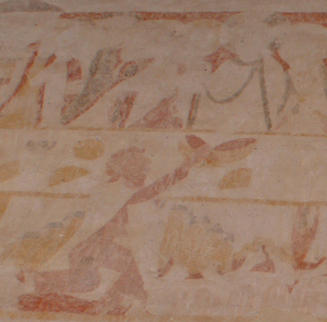
Credit for the picture at the top:
This photo from the Great English Churches website shows a Last Supper from the walls of the 12th-century church in Ickleton, Cambridgeshire, England. Of the image, another photographer, whose website is gone, says "Judas is shown in his traditional position in early painting - on the opposite side of the table to everyone else. He is in the act of taking a fish from a dish, placed immediately in front of Christ, on the table. This may be intended to mean that Judas is a thief, or is greedily taking more than his share. Or of course the appropriation of the fish may be heavily symbolic of his betrayal of Christ. Or both may be intended, as so often."
This page updated May 31, 2024