
Third Sunday of Advent, Year C, December 15, 2024
Most of the short prophecy of Zephaniah is about gloom and doom for faithless, corrupt people and their leaders. But these encouraging words are for a faithful remnant among them. Note the interesting final image of the LORD singing joyfully because of the good people.
When Saint Paul wrote to the good Christians at Philippi, he and they believed Jesus was soon to come again. Paul is confident that the Philippians are ready. He urges them to let their virtue be an example for others.
The preaching of John the Baptizer stirred up expectation that the Messiah had come. People ask John how to be ready to meet the Messiah. His answers are demanding and divisive.
Zephaniah prophesied in Jerusalem during a time when many in that city were faithless and corrupt. Note how he rails against them in the first verses of Chapter 3:
On such as these, Zephaniah insists there will come The Day of the Lord, a time of terrible vengeance and the inspiration for some of John the Baptizer's threats remembered in today's gospel. But all are not lost. There are a few faithful ones whom the Lord will save. The prophet says later in the same chapter:
Your Proclamation: This is the reason for the positive, uplifting tone of today's reading, which concludes Zephaniah's book. Proclaim it as if you're addressing a faithful few in the midst of a godless multitude. That's what Zephaniah was doing.
The Historical Situation: As we noted in last week's Lector's Notes, Paul was very fond of and confident in the Philippian Christians. Perhaps he had more confidence in them than they had in themselves, for he feels the need to bolster their courage in view of what is coming. They believed then that Jesus would return very soon ("The Lord is near.") in glory to judge the world. Paul was sure they'd be ready.
Proclaiming It: So proclaim this as if you want to inspire confidence in a good but worried people. You want them to have three responses to their situation:
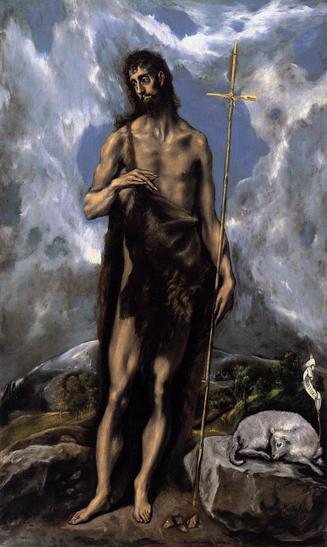
Saint John the Baptist by El Greco (Domḗnikos Theotokópoulos, b. 1541, Candia, d. 1614, Toledo), circa 1600. The online World Gallery of Art says the painting is in The Fine Arts Museums of San Francisco (San Francisco, California, U.S.A.), and gives this description:
This is the finest of the various representations in which this figure of St John the Baptist appears. The attenuated figure, the agitated movement of the sky and the scintillating light on the landscape is characteristic of El Greco's work around 1600. This painting is distinguished from related pictures by the placement of the lamb on the rock - a reference to Christ's sacrifice. The building in the landscape background was identifies as the Escorial.
A similar representation of St John the Baptist is in another painting in the Church of the Jesuits in Toledo, depicting St John the Evangelist and St John the Baptist together.
This page updated December 10, 2024